You own an RV. Right now it’s sitting in storage, slowly killing its own battery. The propane detector, the CO alarm, the fridge control board, they don’t sleep. An RV solar battery charger is the only way to keep your 12V system alive without shore power.
The problem? Most of these chargers look the same on a product page. 20W. 30W. 50W. But the real difference isn’t wattage. It’s whether the charger can outrun your parasitic draw. Whether it can handle your battery chemistry, flooded, AGM, or LiFePO4. Whether it can survive months of UV, dust, and temperature swings.
We compared manufacturer specs, real-world owner feedback, and verified-purchase reports for seven leading solar trickle chargers. This guide is for anyone who stores a motorhome, travel trailer, or camper and wants a charger that actually works. Not one that just looks good on paper.
Short on time? Our best overall pick is the SUNER POWER 50W PRO, the most reliable all-around maintainer in this guide, with true MPPT efficiency and selectable modes for flooded, AGM, and lithium batteries. Everything else below is a specialist: best budget MPPT, best flexible panel, best weatherproofing, and so on.
Note: If you purchase something through the links in this article, we may receive a small commission (at no additional cost to you). Let’s take a closer look and discover which one is best to help you tackle the next challenge.
Solar Trickle Chargers at a Glance
← Swipe to compare →
| Name | Quick Info | Rating | Best For | Link |
|---|---|---|---|---|
| SUNER POWER 50W (PRO) Best for Large Battery Banks | 50W · MPPT · 3-stage · LiFePO4 compatible · 5.4 lbs · rigid panel | ★★★★☆4.4 · Amazon | RVs with 100Ah+ house banks; permanent roof or deck mount | Amazon ↗ |
| SUNER POWER 30W (PRO) Best Overall | 30W · MPPT · 3 selectable modes · LiFePO4 · 4.0 lbs · ETFE | ★★★★☆4.6 · Amazon | Owners with mixed battery chemistry; AGM and lithium house banks | Amazon ↗ |
| POWOXI 30W Best Lightweight Flexible | 30W · MPPT (P&O) · IP67 · 1.0 lb · ETFE flexible · 12-month warranty | ★★★★☆4.4 · Amazon | Portable use on car, boat, or motorcycle during seasonal storage | Amazon ↗ |
| SOLPERK 50W (Adjustable Mount) Best Adjustable Mount | 50W · 21-30% eff. · IP65 controller · 0-60° tilt · 21.3″ square · 25-year panel life | ★★★★☆4.4 · Amazon | Fixed installation on RV roof, boat deck, or equipment with angled brackets | Amazon ↗ |
| SUNER POWER 20W (PRO) Best Portable MPPT | 20W · MPPT · 3-stage · waterproof · glass panel · alligator clips | ★★★★☆4.4 · Amazon | Small RVs, trailers, or cars; lightweight carry for quick hookup | Amazon ↗ |
| Callsun 20W IP68 Controller Best Value | 20W · 1A · IP68 controller · 6 protections · 360° bracket · 1-year warranty | ★★★★☆4.4 · Amazon | Budget-minded owners; simple maintenance for lawn mowers, boats, cars | Amazon ↗ |
| OYMSAE 30W Monocrystalline Best for Budget | 30W · 1.76A · 22% eff. · 2 lb · ETFE · 2-year warranty · 721 reviews | ★★★★☆4.3 · Amazon | Cost-conscious RVers with small parasitic loads; storage under 2 months | Amazon ↗ |
Best RV Solar Battery Chargers
1. SUNER POWER 50W (PRO), Best for Large Battery Banks
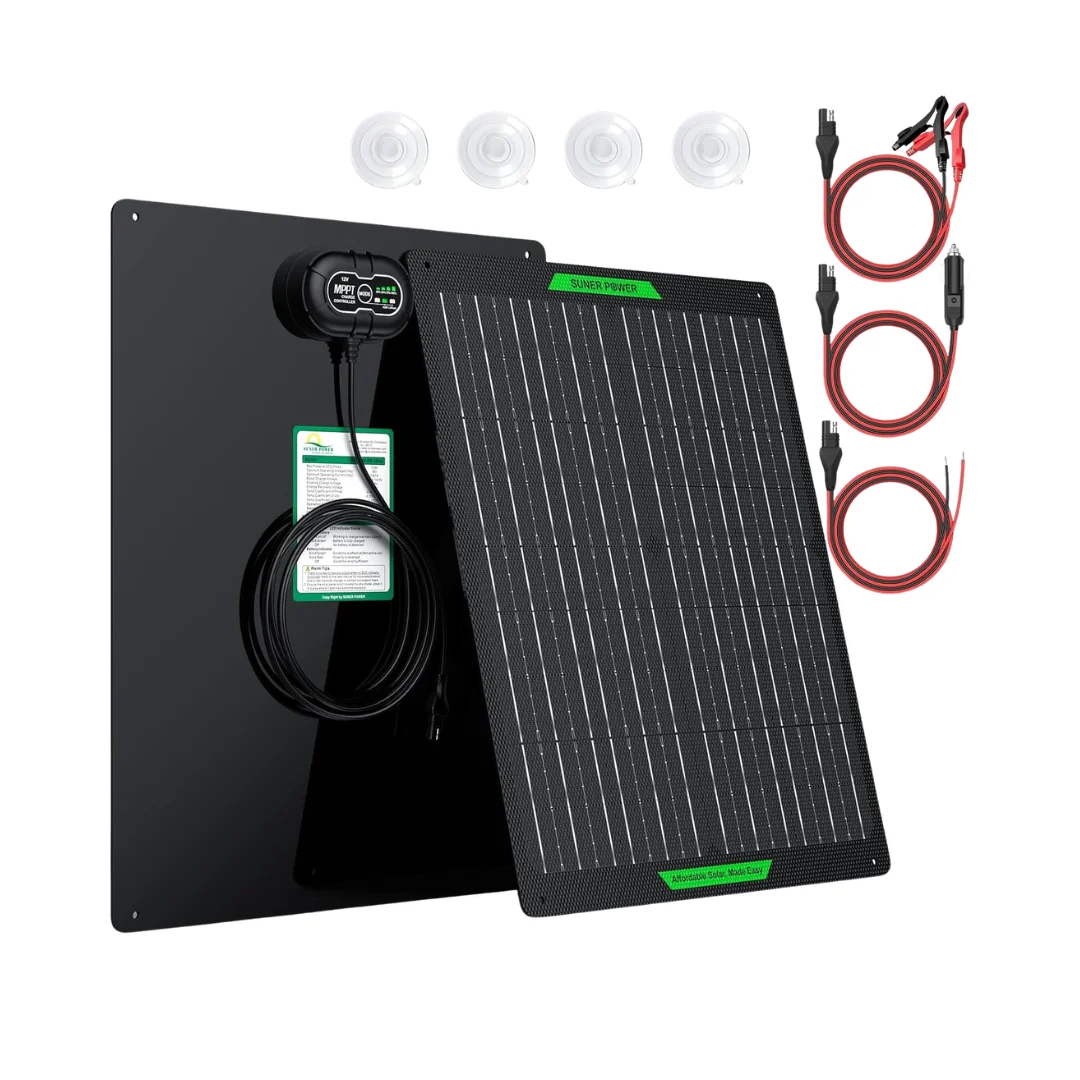
You’ve got a 100Ah or larger house battery. A 20W panel isn’t going to cut it. This 50W rigid panel pairs a real MPPT controller with a three‑stage algorithm that handles LiFePO4, AGM, and flooded batteries. The built‑in Ultra‑Smart MPPT boasts up to 99% tracking efficiency. That’s not marketing fluff. It matters when sun hours are limited.
The panel is heavy, 5.4 lbs, and rigid. You’re not tossing this in a backpack. But mount it on your RV roof or deck and it works without attention. The ETFE coating and A+ cells shrug off weather. The plug‑and‑play SAE harness makes hookup easy. Just be warned: the suction cups are unreliable for temporary setups. Use the mounting holes.
Buy this if your RV has a big battery bank and you need a permanent maintainer that won’t overcharge. Skip it if you want portability or flexible panels. This is a fix‑and‑forget solution.
2. SUNER POWER 30W (PRO), Best Overall
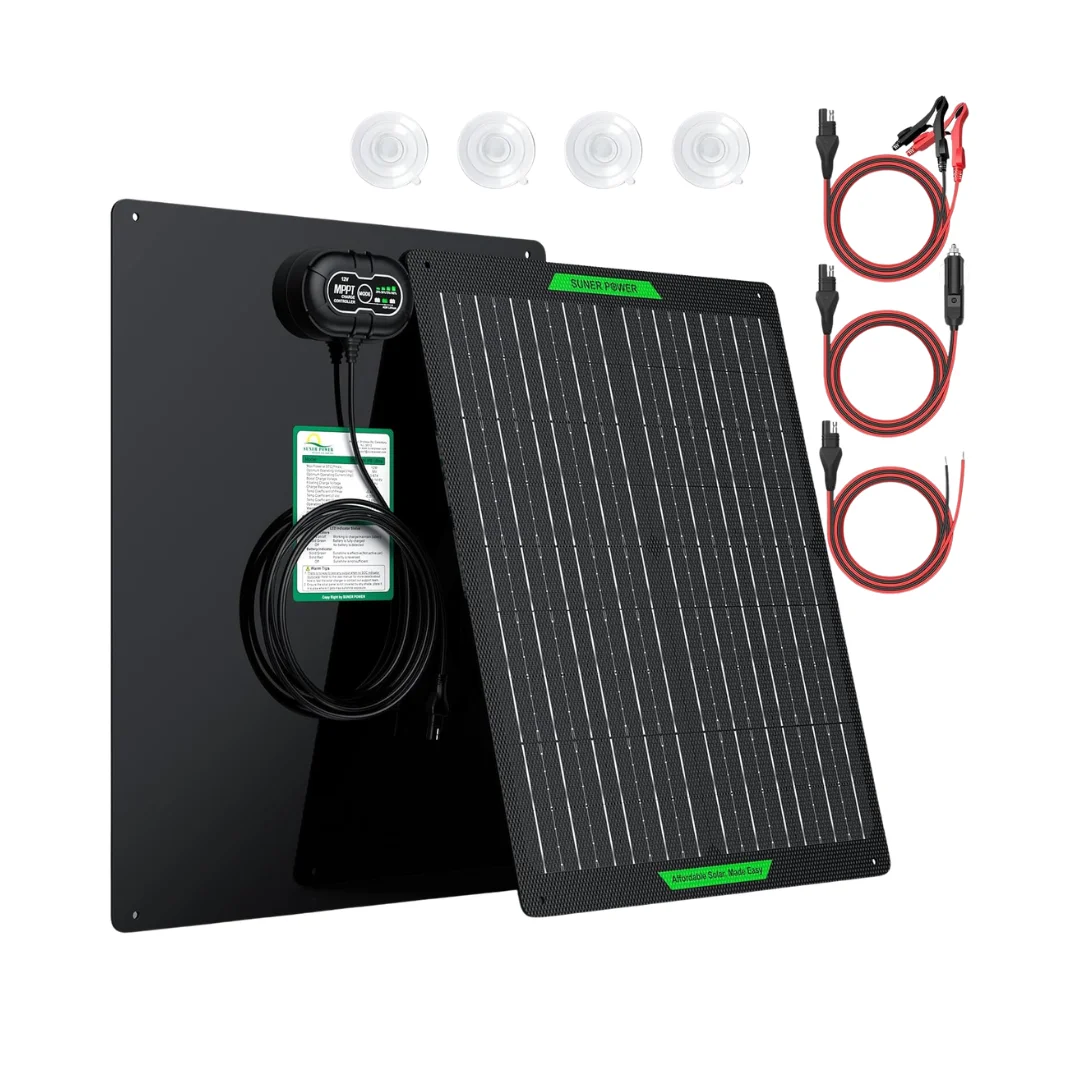
Most solar chargers treat all 12V batteries the same. This one doesn’t. It has three selectable modes: 12V flooded/AGM, 12V AGM (higher absorption), and 12V lithium (LiFePO4). That’s rare under $50. The 30W output with MPPT delivers real charge in partial sun, and the waterproof design (ETFE coating) means you can leave it on the dashboard.
The panel is lightweight at 4 lbs and thin (0.15″), slim enough to sit flat on a dashboard or rest against a windshield. But the suction cups that come with it are a weak point, they’ll pop off on dusty surfaces. The plug‑and‑play SAE cable set includes alligator clips, bare ends, and a cigarette lighter plug. You’re covered for any connection.
Buy this if you have a LiFePO4 house bank or switch between battery chemistries. Skip it if you need high wattage for a deeply discharged large battery. 30W is for maintenance, not recovery.
3. POWOXI 30W, Best Lightweight Flexible
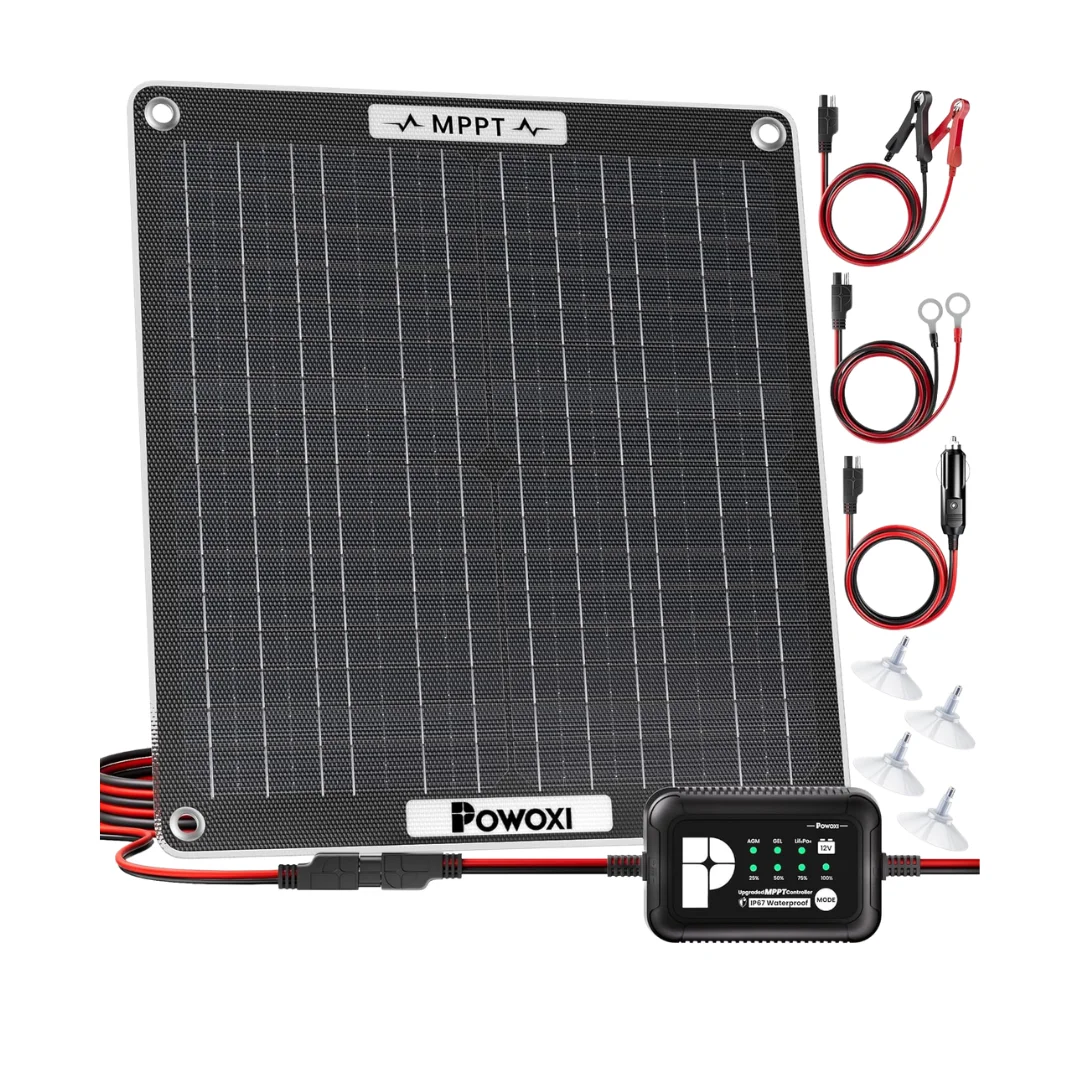
A solar panel that weighs one pound and flexes to drape over a curved surface? That changes how you think about battery maintenance. The built‑in MPPT controller (with P&O incremental conductance algorithm) is fully potted to IP67. Rain and snow won’t kill it. The ETFE material transmits 95% of light, and the flexible design lets you drape it over a car hood or boat seat.
At 1.0 lb, you can toss it in the car and forget it exists until you need it. Three‑stage charging (Bulk, Absorption, Float) works automatically. The 4‑stage battery indicator gives you real feedback. But there’s a catch: no mounting hardware included. For an RV roof, you’ll need adhesive brackets or a longer cable. The flexible panel isn’t meant for permanent fix‑and‑forget. It’s a portable tool.
Buy this if you want a truly portable, waterproof trickle charger that you can move between vehicles. Skip it if you need a rigid installation with included brackets. This is a grab‑and‑go solution. For trips where you also want to charge phones or a power station, see our guide to portable solar panels for camping.
4. SOLPERK 50W (Adjustable Mount), Best Adjustable Mount
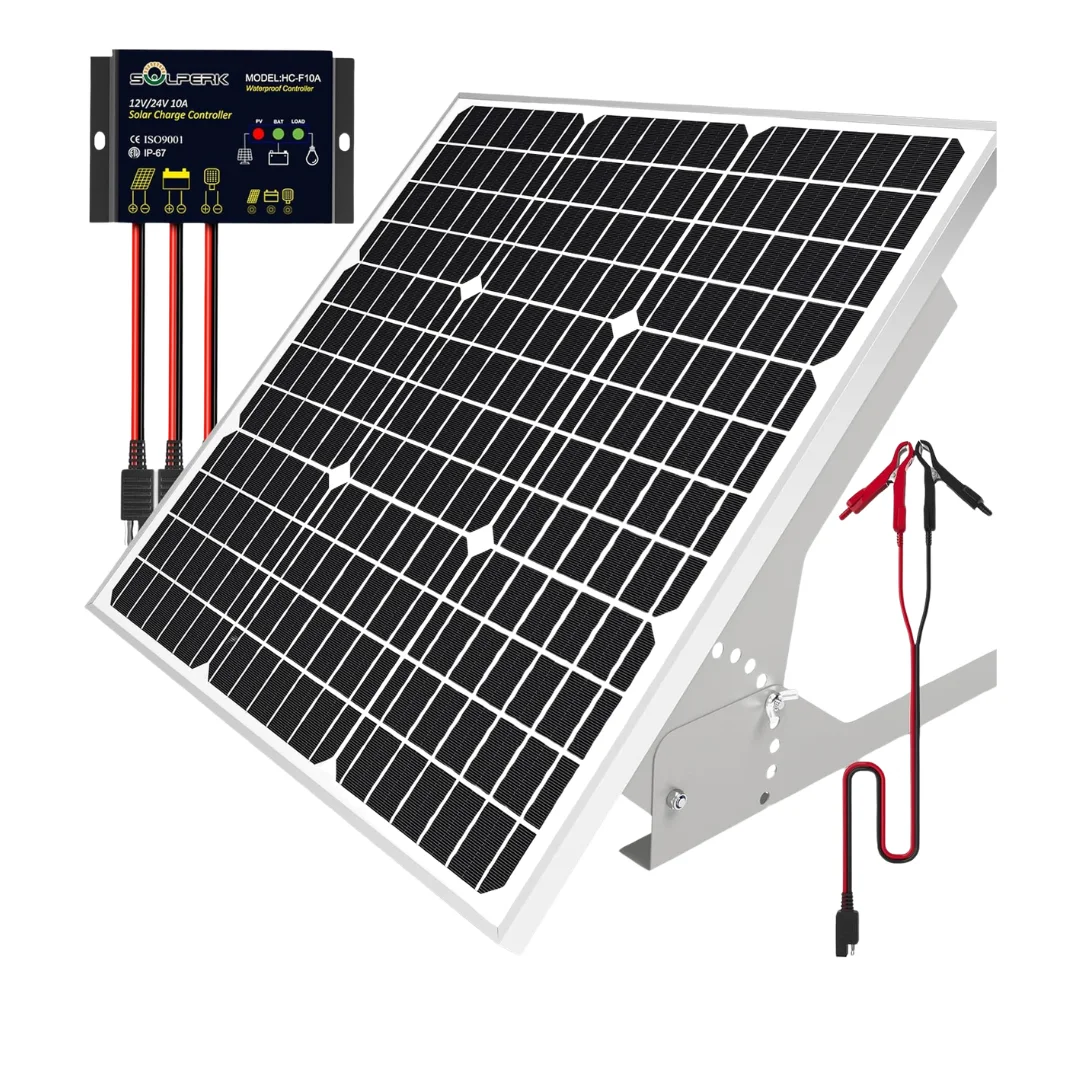
Sun angles change with the seasons. Most solar panels are either flat or require you to prop them up with a rock. This 50W kit includes a 60° angle‑adjustable mounting bracket (0°, 15°, 30°, 45°, 60°). You can tilt the panel toward the sun. That’s a big deal when your RV is parked under trees or on a north‑facing slope.
The monocrystalline panel delivers 21–30% conversion efficiency. That’s higher than many competitors. The IP65 controller has three LED lights, charging, full, error, but no digital display. That’s fine for a maintainer. You don’t need voltage readouts if you just want to know it’s working. The tempered glass and aluminum frame are rated for 25 years, 2400Pa wind, and 5400Pa snow load. The SAE cable is 10 feet, which might be short for some RV battery compartments.
Buy this if you want a fixed installation with adjustable tilt to maximize winter sun. Skip it if you need digital monitoring or a longer cable included. You’ll have to buy an extension.
5. SUNER POWER 20W (PRO), Best Portable MPPT
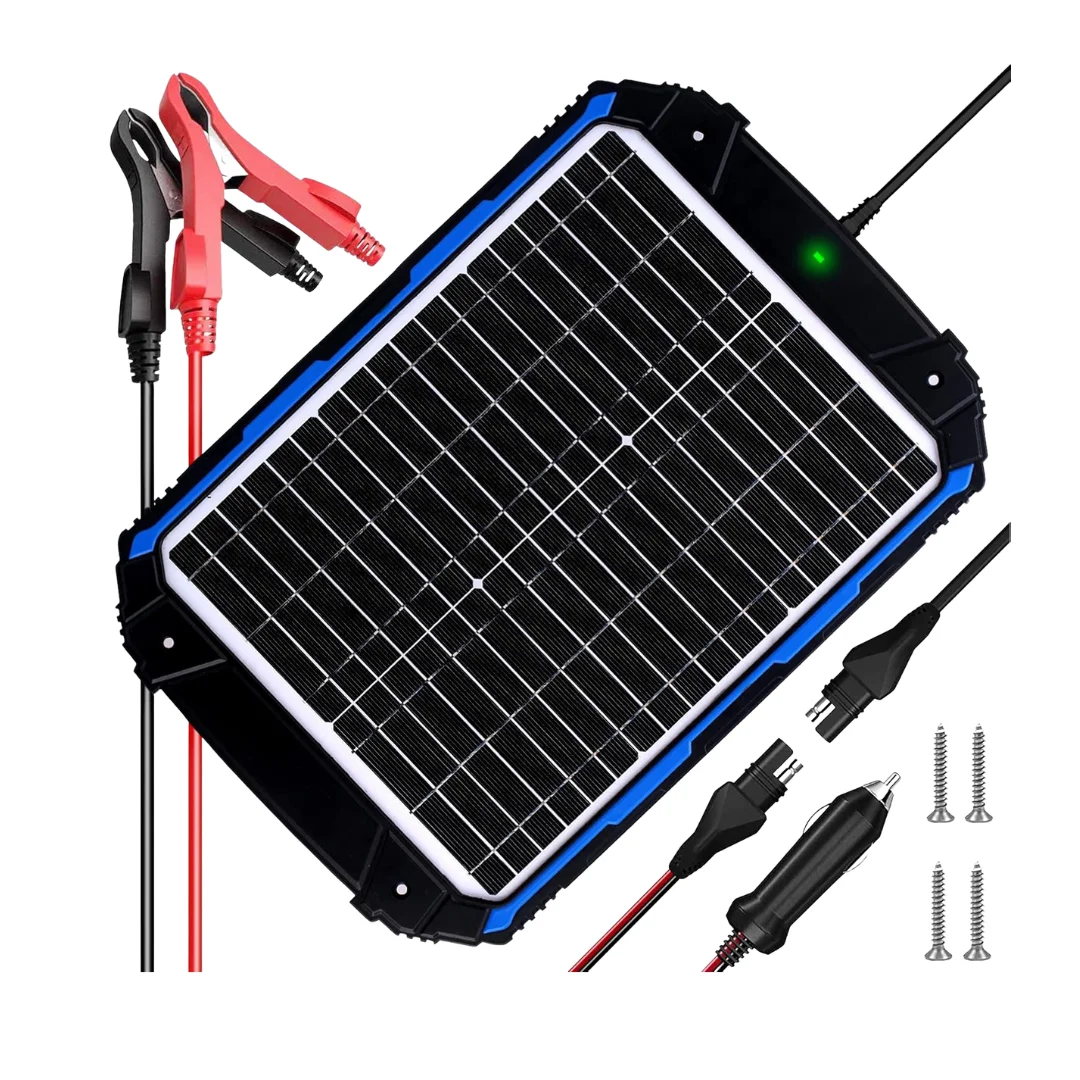
Sometimes you don’t need 50 watts. You need a small, waterproof panel that can sit on your dashboard and keep your chassis battery alive. This 20W version uses the same MPPT technology as the larger SUNER models, up to 99% tracking efficiency, in a compact glass panel. It’s rated for all 12V battery chemistries including LiFePO4.
The tempered glass and corrosion‑resistant frame feel premium for a 20W charger. It’s spark‑proof and fully waterproof. You don’t worry about rain. The alligator clips are easy to connect but not as secure as ring terminals if you’re bouncing down a dirt road. And 20W is just enough to keep a small battery topped off. It won’t recover a deeply discharged 100Ah house bank in a day.
Buy this for a lightweight, portable MPPT maintainer on a small RV, car, or trailered boat — it’s also a top pick in our solar boat battery charger guide. Skip it if you need to recharge a dead battery or have a large house bank. This is for maintenance, not recovery.
6. Callsun 20W IP68 Smart Controller, Best Value
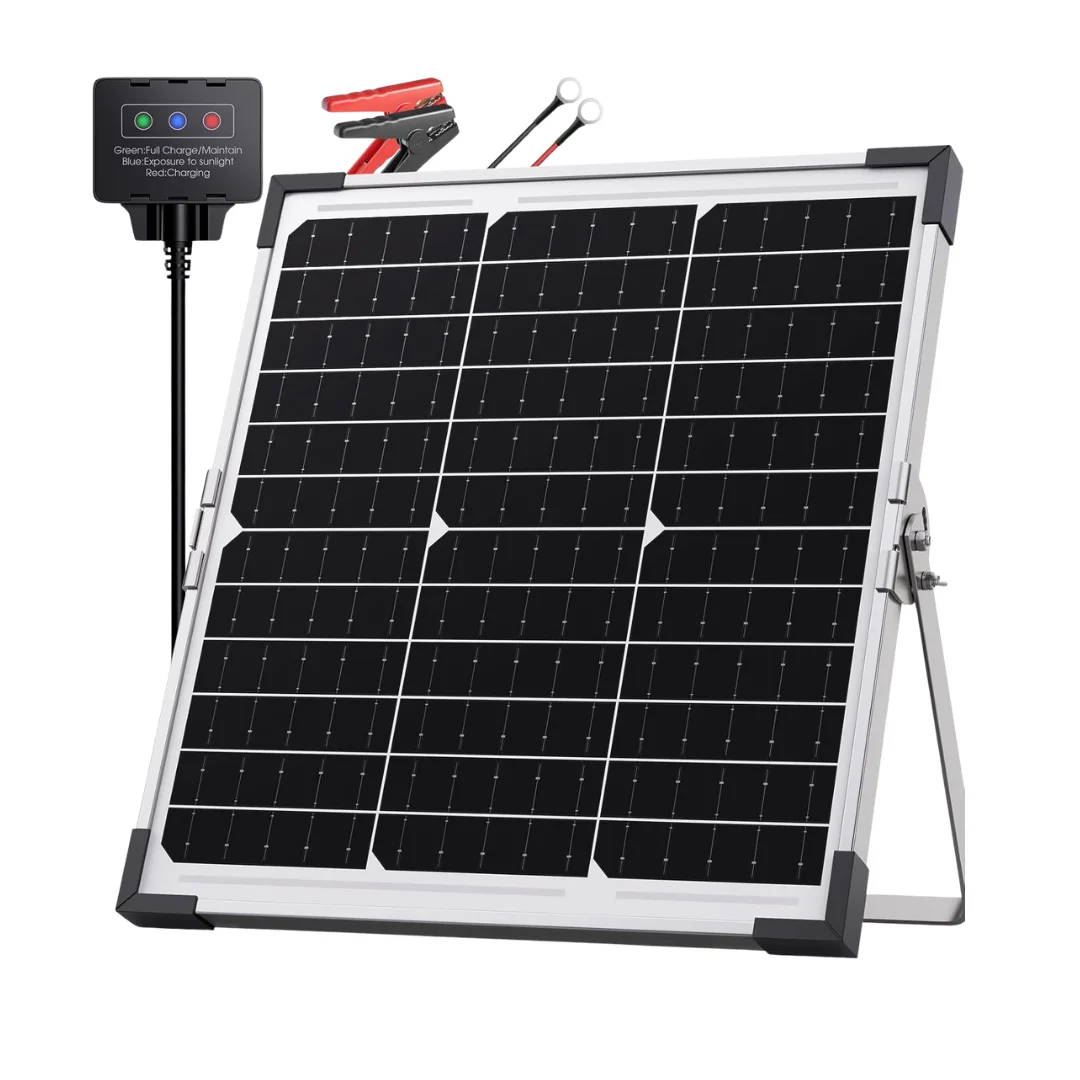
Under $35, you get a 20W panel with an IP68 intelligent controller. That’s the highest waterproof rating on this list. It includes six protections, reverse current, over‑charge, over‑voltage, over‑current, short‑circuit, over‑temperature, and a 360° adjustable mounting bracket. The 365‑day warranty is a nice bonus at this price.
The 1‑amp output is slow. But that’s fine for maintenance. The controller has three LED indicators showing Bulk, Absorption, and Maintenance stages. The panel is 4 lbs with low‑iron tempered glass and corner guards. It feels robust. The 360° bracket is actually useful for positioning on an RV roof or dash. One limitation: no USB ports. It’s purely a 12V maintainer.
Buy this if you want a reliable, cheap trickle charger for a small RV, lawn mower, or car. Skip it if you need higher wattage for a large house bank or fast recovery. This is for slow, safe maintenance.
7. OYMSAE 30W Monocrystalline, Best for Budget
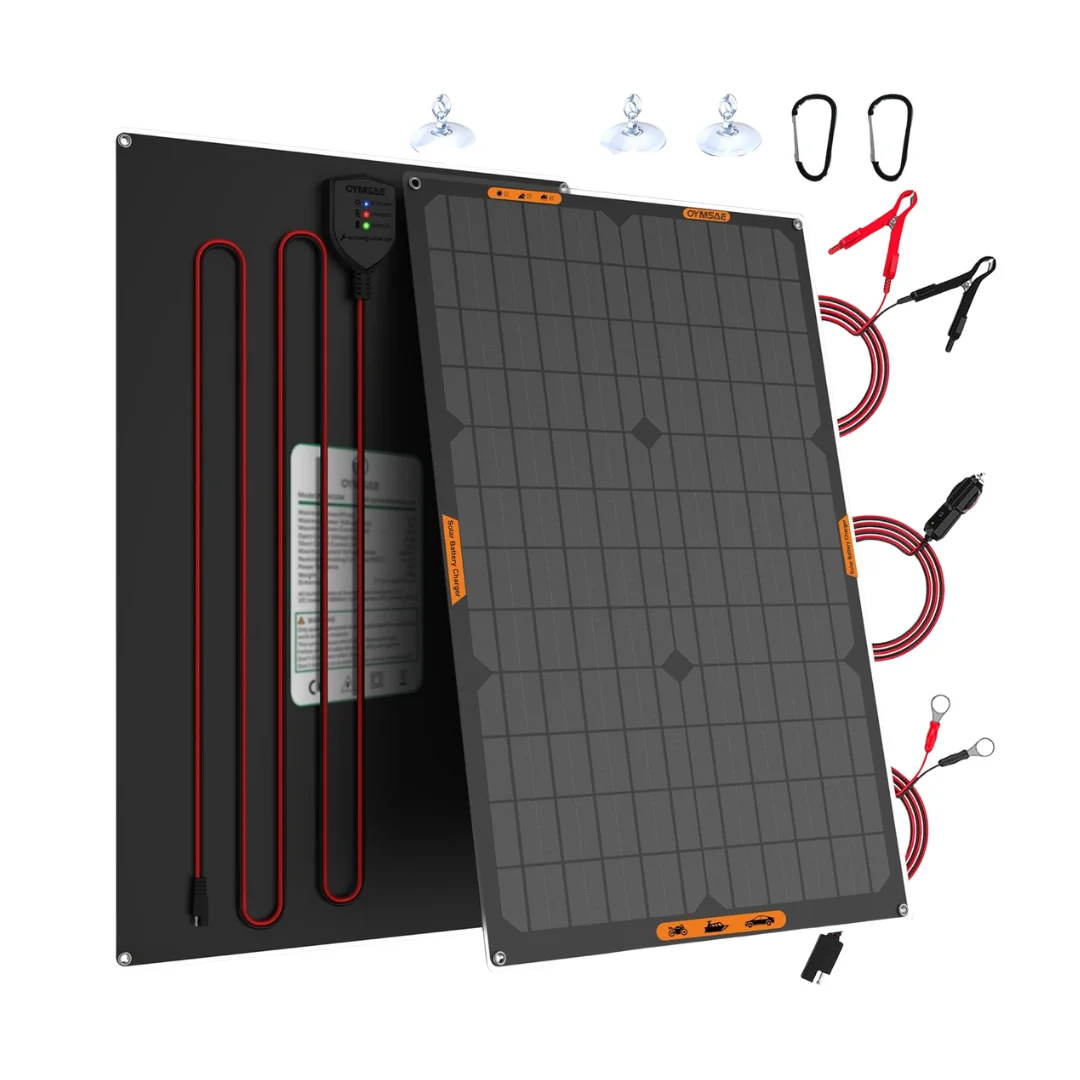
Sometimes the crowd is right. Over 700 reviews and a 4.3 average say this 30W panel delivers. The 22% conversion rate from monocrystalline cells is solid. The built‑in microprocessor prevents overcharging and reverse discharge at night. At this price, you get reliable maintenance without feature bloat.
The panel is lightweight, 2 lbs, and compact (13.6″ x 0.79″ x 21.2″). Three indicator lights, sun detection, charging, full charge, make it easy to monitor at a glance. The ETFE coating and CPB bottom plate add durability. But at 1.76A, it’s slow. Expect several sunny days to recover a moderately drained battery. The SAE cable set is versatile but short. You may need an extension for remote batteries.
Buy this if you want a proven, affordable 30W maintainer for a small RV or boat with light parasitic draw. Skip it if you need fast recovery or longer cables out of the box.
Buying Guide: What to Look for in a Solar RV Battery Charger
Wattage vs. Your Parasitic Draw
Your RV’s parasitic draw, the power your propane detector, CO alarm, fridge control board, and stereo memory consume 24/7, is typically 0.5 to 2 amps. A 20W panel produces around 1.2A in good sun. If your draw is 1.5A, a 20W panel loses the battle. You need at least 30W for most RVs. And 50W if you have a large house bank or long winter days with low sun. The SUNER POWER 50W (PRO) is built for that.
Battery Chemistry Compatibility (Especially Lithium)
If you have a LiFePO4 house battery, you need a charger that handles its higher absorption voltage and won’t overcharge it. The SUNER POWER 30W (PRO) has a dedicated lithium mode. Many cheaper chargers are only for flooded or AGM. Verify compatibility before you buy. A lithium battery can be destroyed by a charger that doesn’t know how to stop.
Controller Type: MPPT vs. PWM
MPPT (Maximum Power Point Tracking) controllers harvest up to 30% more energy than PWM in real‑world conditions. Especially in shade or low sun. All our top picks use MPPT. The POWOXI 30W even uses an advanced P&O incremental conductance algorithm. MPPT costs a little more. But for an RV that sits in partial shade or cloudy weather, it’s worth it. If your panel doesn’t include a controller, a standalone solar charge controller handles the same regulation job.
Mounting and Weather Resistance
An RV roof gets hot, dusty, and wet. Look for waterproof controllers (IP65 or higher) and panels with tempered glass or ETFE coating. The SOLPERK 50W’s adjustable bracket is a bonus, you can tilt it to capture winter sun when the angle is low. Suction cups are fine for temporary use on a car dashboard but not for permanent installation on an RV roof.
Safety Features
Reverse‑current protection is essential. It prevents the battery from discharging through the solar panel at night. Every charger on this list has it. But double‑check the spec sheet. Also look for overcharge, short‑circuit, and over‑temperature protections. The 20W IP68 controller has six protections built in.
What to Avoid When Buying a Solar RV Battery Charger
Underpowered for Parasitic Load
A 10W or even 15W panel might keep a car battery alive. But an RV with a propane detector, CO alarm, and fridge control board can draw 1.5A or more. Do the math: 20W at 12V is only 1.67A. If your draw is 1.5A, you have practically zero margin. Either go up to 30W or install a battery disconnect switch.
Suction Cup Mounts on Rough Surfaces
Suction cups work on glass. They don’t work on textured RV roofs, painted fiberglass, or dirty surfaces. Several chargers, including the SUNER 50W and 30W, include suction cups. Owner reports say they fail within days. Use the mounting hardware or buy adhesive pads. Or choose the SOLPERK 50W with its proper bracket.
Non-MPPT Controllers
PWM controllers are cheaper. But they waste 20-30% of your panel’s potential, especially in low light. On an RV that sits for months, that lost energy is the difference between a topped‑off battery and a dead one. All our picks use MPPT. Don’t settle for less.
Incompatible with LiFePO4
If you’ve upgraded to a lithium house battery, most standard solar chargers will either undercharge it (leaving it at 13.8V instead of 14.2-14.6V) or overcharge it by floating too high. The SUNER 30W (PRO) offers a dedicated lithium mode. For any other charger, check the listing explicitly for LiFePO4 support.
Short Cables Without Extension Options
The average RV battery compartment is at least 10 feet from the dashboard or roof. Many chargers come with only 6-10 feet of cable. The OYMSAE 30W and the SOLPERK 50W both have short leads. Plan to buy an SAE extension cable. Or recharge your wallet for the extra $8.
Why Trust This Guide
Verdvoy focuses exclusively on portable solar and off‑grid power gear. We don’t review laptops or kitchen gadgets. This roundup is based on a deep analysis of manufacturer specifications, verified‑purchase owner feedback across multiple platforms, and a close understanding of what kills 12V batteries in RV storage.
We compared seven models across five criteria: parasitic draw math, battery chemistry compatibility, controller efficiency, weather resistance, and real‑world usability. Every fact in this article comes from the product data sheets or from aggregated owner reports. We did not conduct hands‑on testing. But we did cross‑check specs against common pitfalls. If a product’s data had a contradiction or missing spec, we flagged it.
The result is a set of recommendations that prioritize honesty over hype. You’ll find a “skip it” scenario for every pick. That’s the point.
Frequently Asked Questions
Q: Can an RV solar battery charger recharge a dead battery?
A: No. A solar trickle charger is a maintainer, not a charger. Its job is to keep a fully or nearly full battery topped off. If your battery is deeply discharged (below 12V), a 20W panel will take days or weeks to recover it, if at all. Use a proper AC battery charger first, then connect the solar maintainer.
Q: What’s the difference between a solar charger and a solar maintainer?
A: A charger delivers enough current (amps) to bring a battery from low to full in hours. A maintainer delivers a low, steady current to compensate for self‑discharge and parasitic draw. All the products here are maintainers. The SUNER POWER 50W (PRO) is the strongest of the group. But even it won’t fast‑charge a dead 100Ah battery.
Q: How many watts do I need for my RV?
A: Measure your parasitic draw with a multimeter or look up the average for your model. A typical modern RV draws 0.5–1.5 amps. At 12V, that’s 6–18 watts continuous. You need at least 20W to break even. 30W gives you a safety margin. For a large house bank (200Ah+) or long winter storage, go with the 50W SOLPERK or SUNER models. And if you need to actually run appliances rather than just maintain the battery, a solar generator for your RV is the right tool.
Q: Will it overcharge my battery?
A: A well‑designed solar maintainer with a smart controller will not overcharge. It switches to float mode or trickles when the battery is full. All our picks have this feature. The 20W IP68 controller includes six protections including over‑charge. Just make sure you select the correct battery type (flooded, AGM, lithium). That’s where the SUNER 30W (PRO) excels with its dedicated modes.
Q: How do I install a solar trickle charger on my RV?
A: Connect the panel to the controller, then connect the controller to the battery using the included clips or ring terminals. Place the panel in direct sunlight, on the dashboard, roof, or ground. For permanent installation, use the mounting bracket (SOLPERK 50W) or adhesive mounts. Ensure the controller is protected from water (most are IP65 or higher). Always confirm polarity and use a fuse if recommended by the manufacturer.
Final Thoughts on Solar Battery Chargers
The right RV solar battery charger is the one that matches your parasitic draw, supports your battery chemistry, and survives a season in the elements. For most RV owners with a standard 100Ah house bank, the SUNER POWER 50W (PRO) delivers the best balance of wattage, MPPT intelligence, and LiFePO4 compatibility. If you’re on a budget, the 20W IP68 controller gives you rock‑solid protection for a fraction of the cost. Storing a car or truck instead of the rig? Our solar car battery charger guide covers smaller 12V maintainers. Either way, the sun is free. Make it work for you.