We’ve tested the top solar car battery chargers for cars (12V trickle chargers/maintainers) for 2025, in anticipation of 2026. In this guide I am going to share what I discovered, my favorite picks (from reputable brands such as Renogy and EcoFlow), plus some tips for maintaining your car, RV or camper
battery healthy. We’ll explain how these devices work, why you need one, what features to look for and the noteworthy models—so you can charge on-the-go, save cash and the planet. For car owners and vagabonders, a quality solar maintainer is your insurance policy against having a dead battery. Let’s dive in!
Ready to find out which solar phone chargers are actually worth it this year? Let’s get started.
Our Top Picks
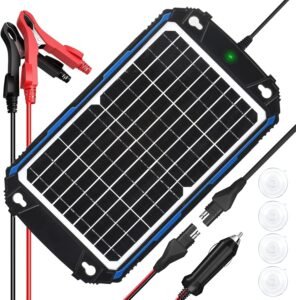
Top 7 Trickle Chargers and Maintainers
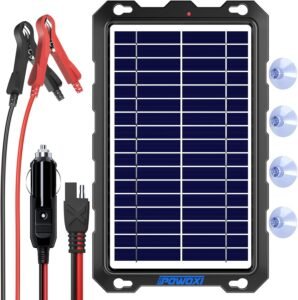
1. POWOXI 7.5W Solar Battery Trickle Charger & Maintainer
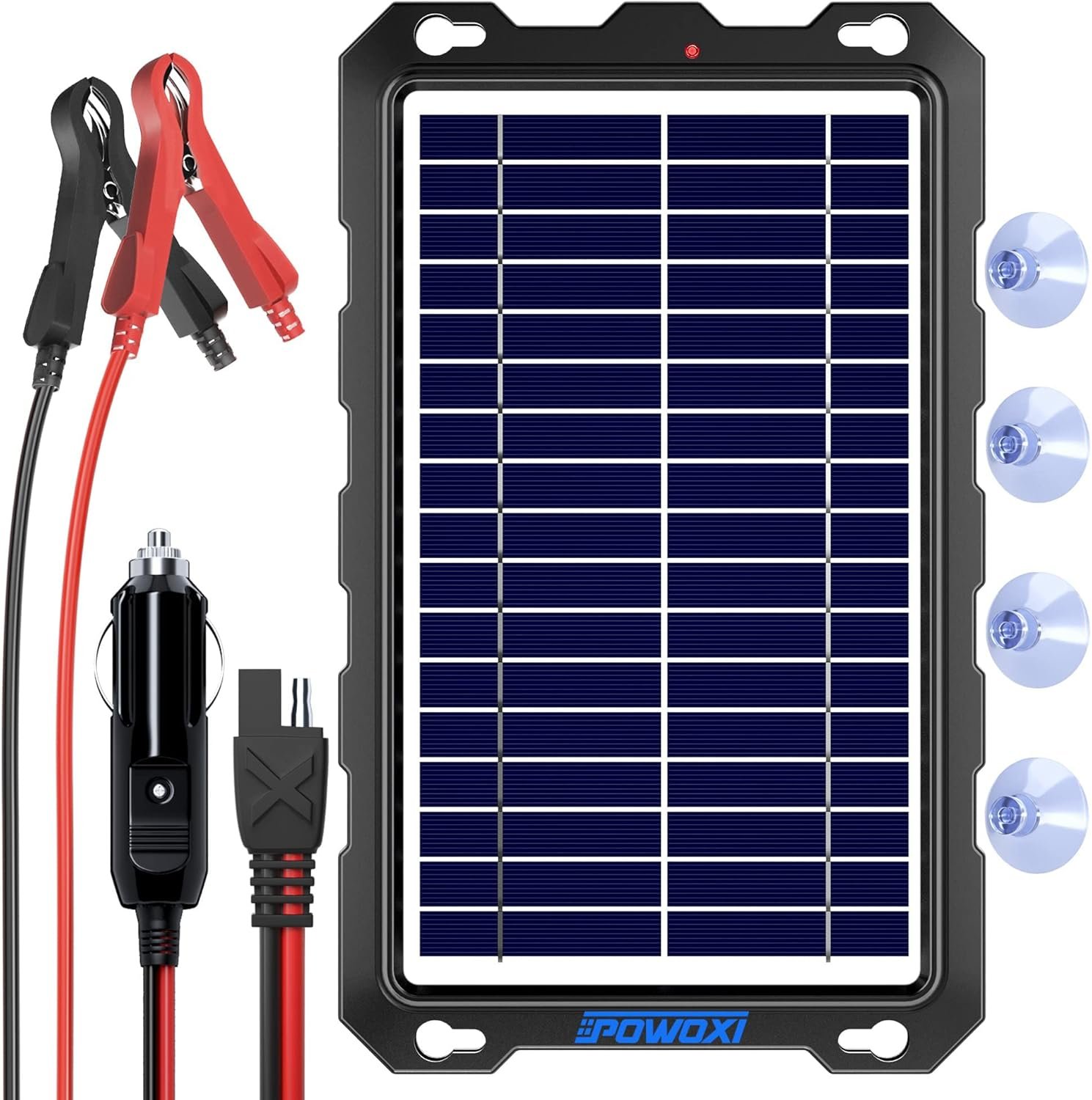
Want to use your 12V batteries all year round without the hassle of a dead vehicle? The POWOXI 7.5W Solar Battery Charger has high Amazon ratings, for example. It has a smart protection system that ensures a stable 7.5W output and a firm/transparent tempered glass that can be used outdoors for a long time.
This trickle charger’s ABS and PC frame, unlike those of cheaper panels, is also sturdy and scratch-resistant for your car dashboard. It has overcharging, discharging, reverse connection, and short-circuit protection.
You can use this trickle charger as a vehicle; simply plug it into your car’s cigarette lighter, or alternatively, connect it directly to the battery with alligator clips. An LED indicator shows when the panel is receiving sunlight to charge your battery.
A simple, inexpensive (under $40) trickle charger like this is a good option for keeping cars and seasonal equipment charged.
2. SUNER POWER 12W Solar Battery Charger & Maintainer Pro
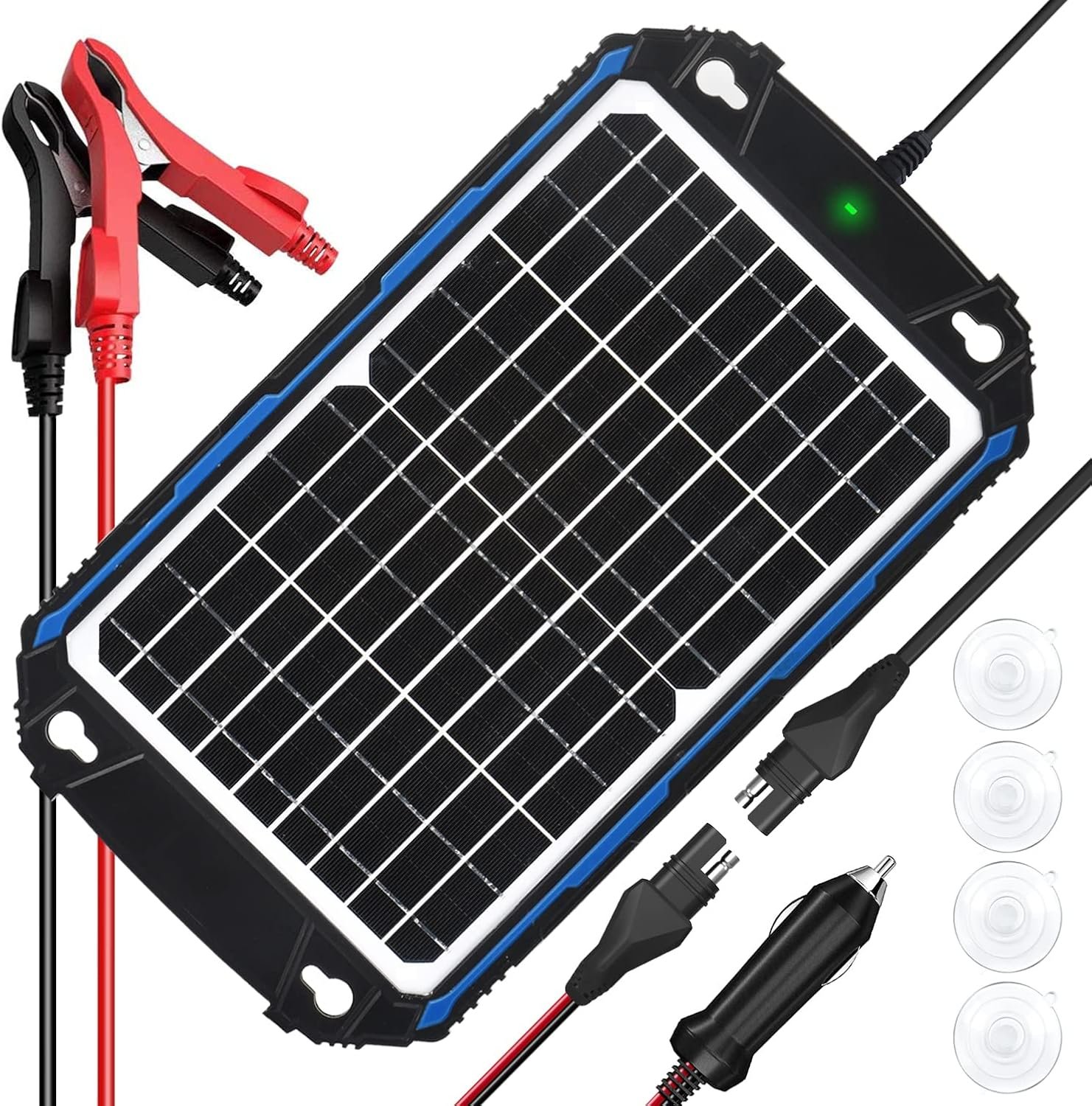
The SUNER POWER 12W Pro is one of the best budget 12V solar trickle chargers available for under $60. The charger differs from traditional budget models with basic PWMs that offer only 3%-6% power conversion efficiency; instead, this charger features Ultra-Smart MPPT technology that, under certain conditions, can convert up to 30% more energy than the original model.
This means this trickle charger starts charging earlier in the day, works well in partial shade, and continues charging even in winter sunlight. Its 3-stage charging protocol (Bulk, Absorption, and Float) provides your battery with a full charge without overcharging or damaging it, making it perfect for vehicles in long-term storage, such as RVs, boats, and cars stored in barns.
This solar battery charger is fully automatic. It ceases charging when the battery is full and resumes charging after a voltage decrease. You can set it and forget about it. It also provides powerful protection against reverse polarity, overcurrent, overheating, overvoltage, short circuits, and sparks – all housed in a waterproof case.
If you need an actual 12V solar maintainer with genuine MPPT charging, unlike many fly-by-night trickle chargers on the market, this model offers improved performance over most of them.
3. POWOXI 15W MPPT Solar Car Battery Charger
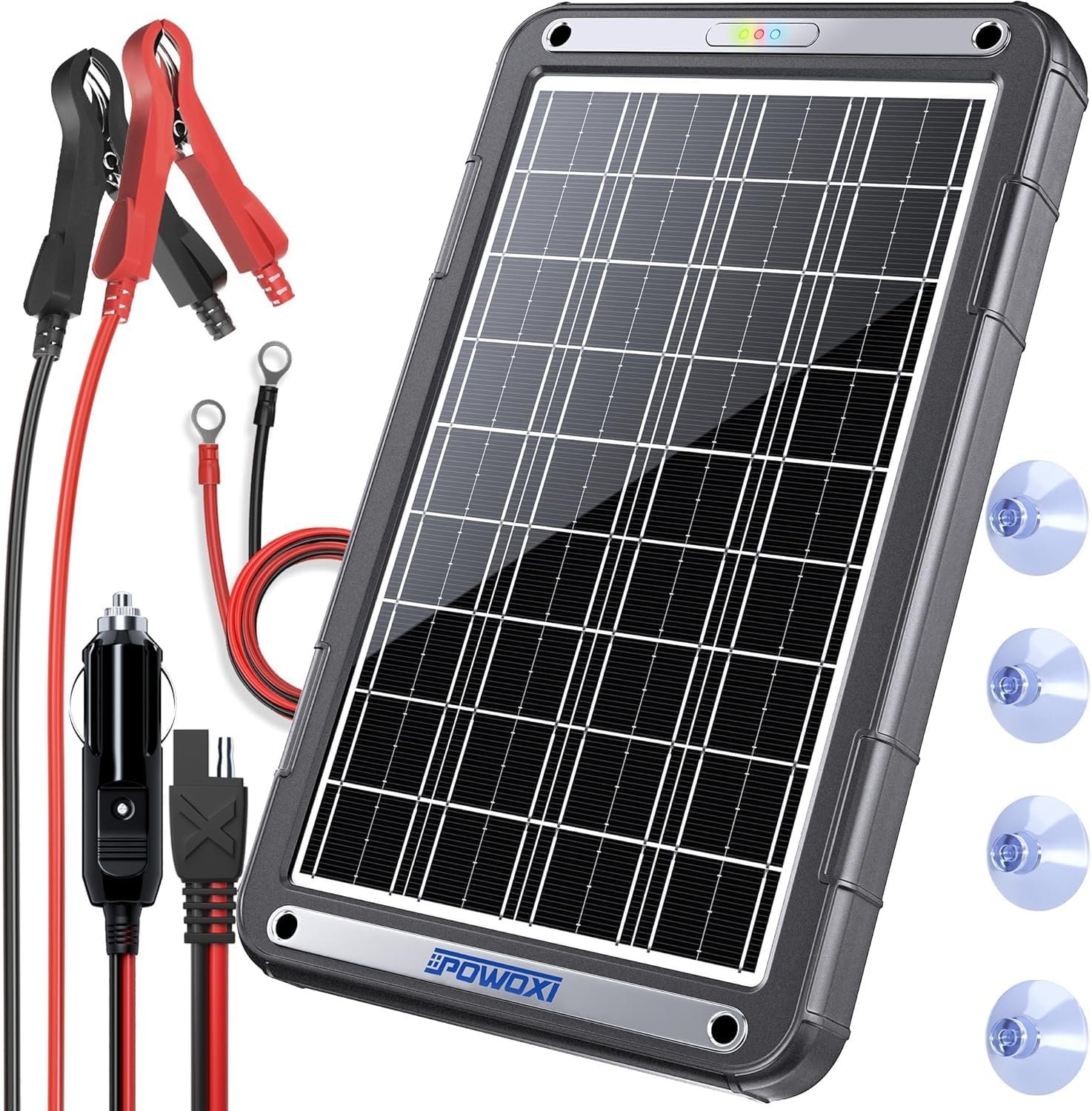
The POWOXI 15W MPPT Solar Battery Charger features a built-in maximum power point tracking (MPPT) controller that enablesto it operate at its highest efficiency, up to 99% more than a traditional charger. This charger adapts its output to sunlight intensity far more efficiently than lower-cost PWM models, so you can enjoy faster, more reliable charging even on overcast days.
The panel is made from high-performance monocrystalline silicon, tempered glass, and a PC+ABS frame, which provides long life and enhanced cell performance. They are fully IP65 waterproof and impact resistant, so they can withstand temperatures ranging from –40°C to 137°C – perfect for outdoor use in any season.
Status monitoring is simplified with three indicator LEDs:
Blue → receiving sunlight
Red → charging
Green → battery full
This model is perfect for cars that sit in storage, such as RVs. It is not a charger that will bring a dead battery back to life, but as a maintenance charger, it’s one of the most efficient we’ve seen at its price point.
4. Voltset 20W Solar Battery Charger & Maintainer (IP67, Smart Controller)
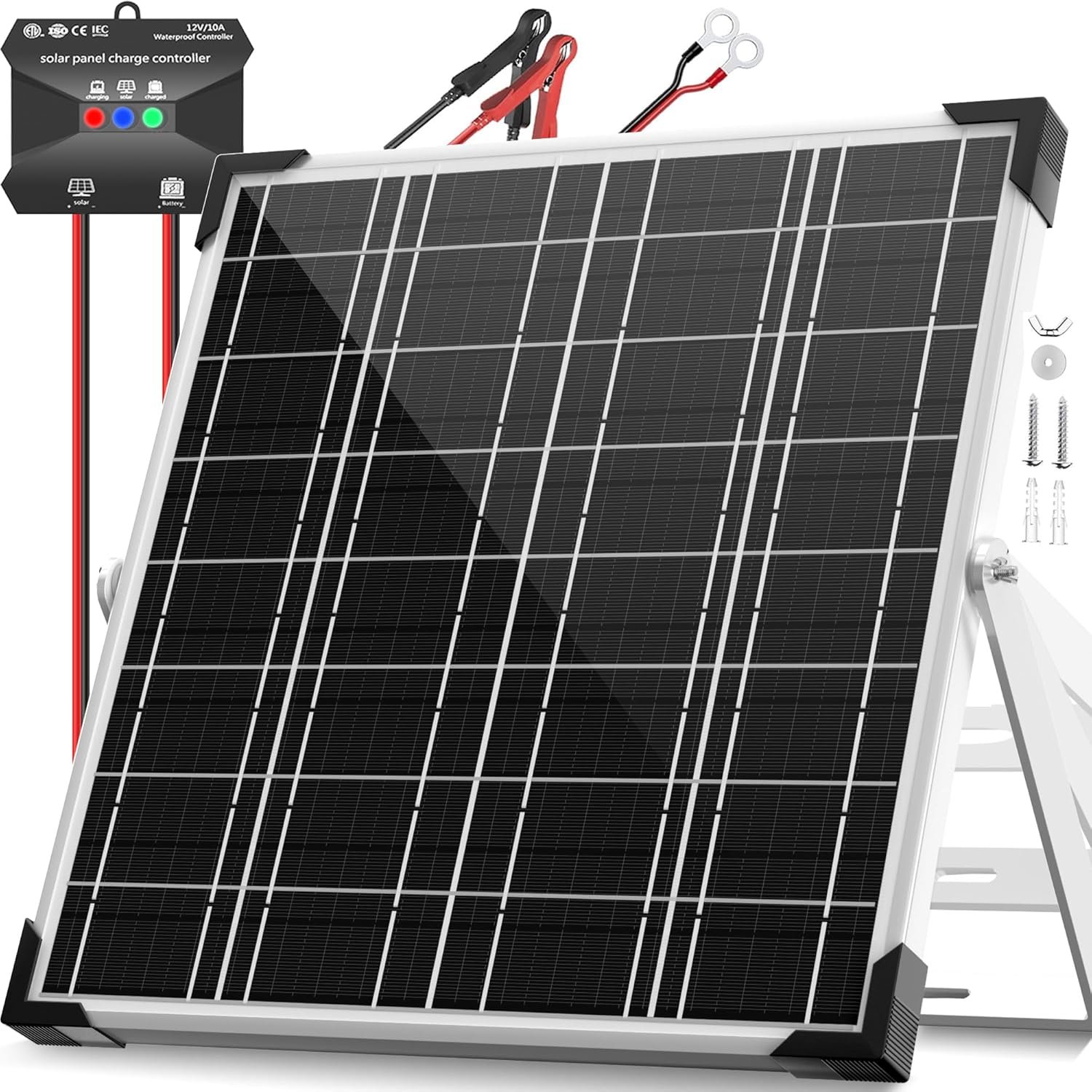
Voltset 12V 20W Solar Battery Charger is one of the best mid-range trickle chargers from 2025 to 2026, featuring high-performance monocrystalline panels and a full-featured IP67 smart controller, which you usually only see on premium models.
A standout feature is the ultra-smart MPPT-like regulation, maximising daylight conversion (up to 99.3% efficiency) and preventing reverse drain at night (less than 0.1mA). It has an internal 3-stage charging system (Direct → Float → Trickle) which allows it to be used with LiFePO4, Lithium, AGM, SLA, GEL, and more.
A 360°-adjustable aluminium bracket enables true sun-tracking. This boosts daily solar radiation absorption by one-sixth—an advantage when camping year-round. The foldable frame is 20% smaller for vastly improved portability, yet maintains durability and strength. This results in some of the smallest storage dimensions for cars, boats, motorcycles, RVs, and off-grid equipment maintenance.
This trickle charger is ideal for unattended, parked vehicles, seasonal equipment (ATVs and lawn mowers), ski boats, and lawn tractors.
5. ECO-WORTHY 25W Solar Battery Charger Kit (12V Trickle Charger and Waterproof Controller)
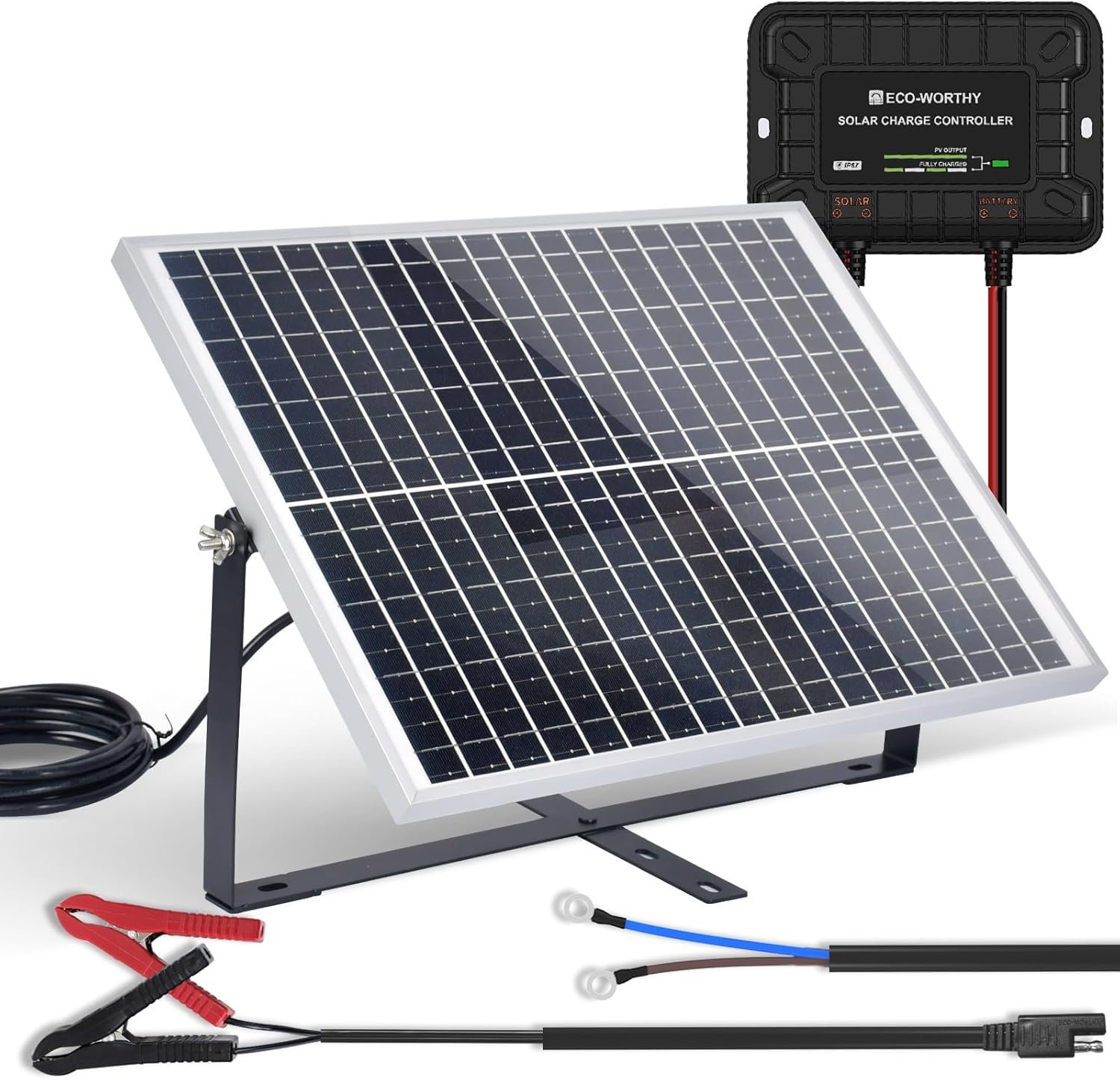
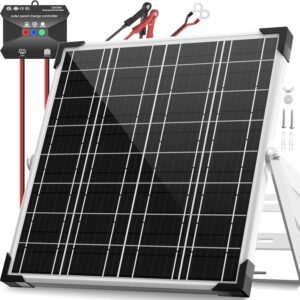
The ECO-WORTHY 25W Solar Panel Kit is a useful and budget-friendly upgrade over typical 10–20W trickle chargers. 25W of A+ grade monocrystalline power, providing up to 100Wh per day in good sunlight, is enough to maintain 12V batteries and power small off-grid devices such as pumps, lights, and micro-IoT systems.
A new waterproof pulse-width modulation (PWM) charge controller is included, featuring a fully sealed design for outdoor use. It features protection against over-voltage, over-discharge, overload, and short-circuits, as well as temperature compensation for safer long-term battery health. It draws no power in the dark, which saves the battery.
The solar panel uses low-iron tempered glass and an anti-corrosive aluminum frame. This ensures durability and reliable performance. It withstands thunderstorms, winds up to 2400 Pa, sand, hail, and snow loads up to 5400 Pa.
For people maintaining parked cars, farm equipment, RV batteries, gate openers, fencing systems, and boats, this kit is a trusted all-weather workhorse.
6. FlexSolar 20W Solar Battery Charger & Maintainer (12V)
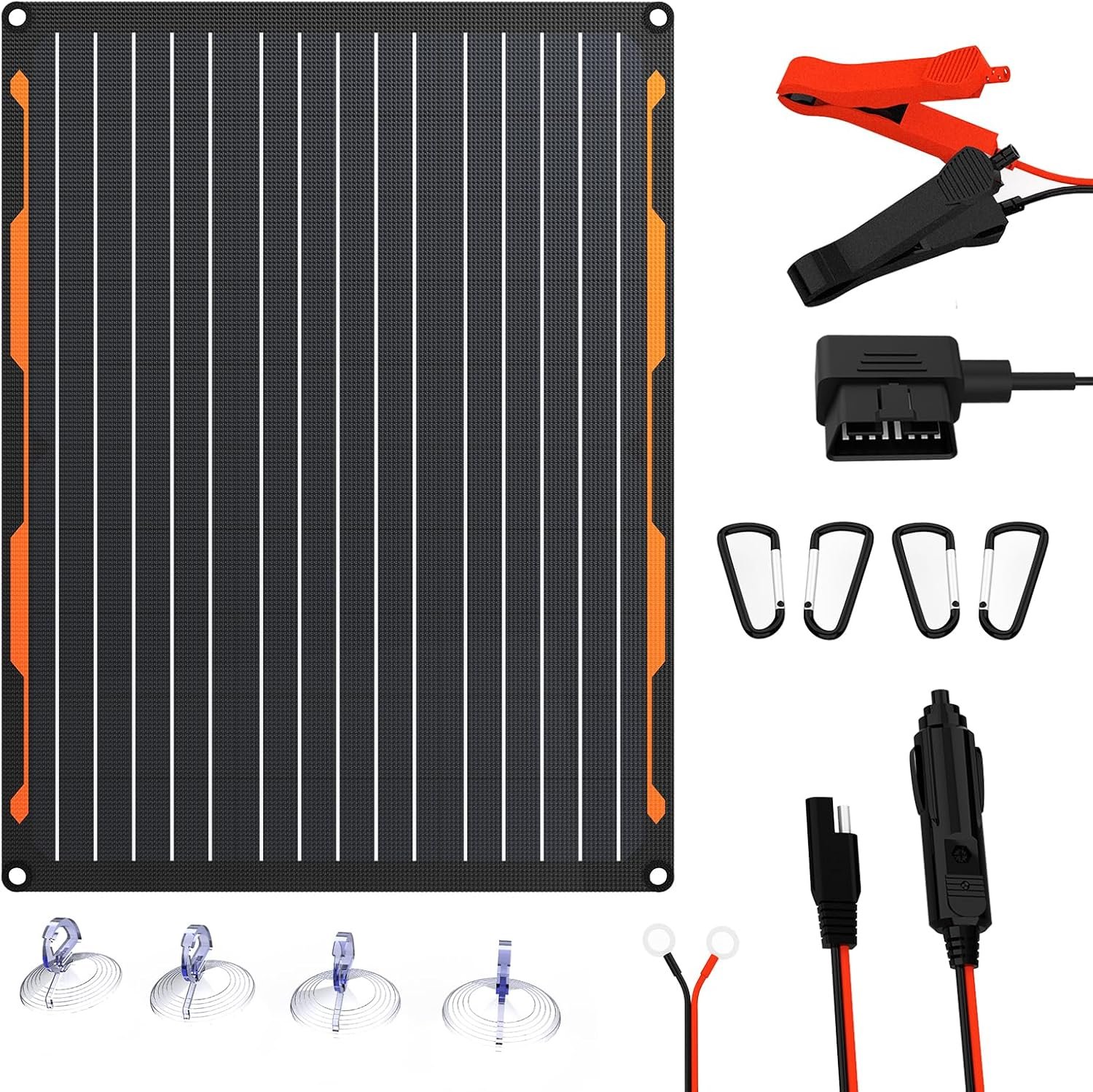
Vehicle and equipment owners looking for a reliable, lightweight 5W solar solution need look no further than the FlexSolarTM 20W Solar Battery Charger Kit. Featuring high-efficiency 20-25% monocrystalline cells, it performs better in less-than-optimal light conditions than older panels of the same size.
Its onboard smart controller monitors and controls the charging process to keep the battery at a proper charge level, delivering a significant bulk charge when needed, helping to get your five-day weekend started off right with plenty of power. Then, if the battery drops off later, the controller resumes charging and returns to zero reverse drain during the nighttime.
FlexSolar is most impressive, however, with the number of devices it’s compatible with. Having four connection types in one kit:
1. Cigarette lighter plug
2. Alligator clips
3. O-ring terminals
4. OBDII connector (rare in this price range)
That means this trickle charger is perfect for keeping 12V batteries charged in your car, truck, tractor, motorcycle, boat, and so much more, including electric fences, deer feeders, and fish finders. It’s not for charging dead batteries, but it is great at preventing parasitic drain and helping keep vehicles “ready to start.
The kidney grille and slim headlights flank each side of the bonnet to help reduce bulk, but not by much – at 1.7kg per unit and 0.11 inches thickness, these are among the lightest rigid-panel kits on the market.
7. ECO-WORTHY 10W Solar Car Battery Charger & Maintainer (12V)
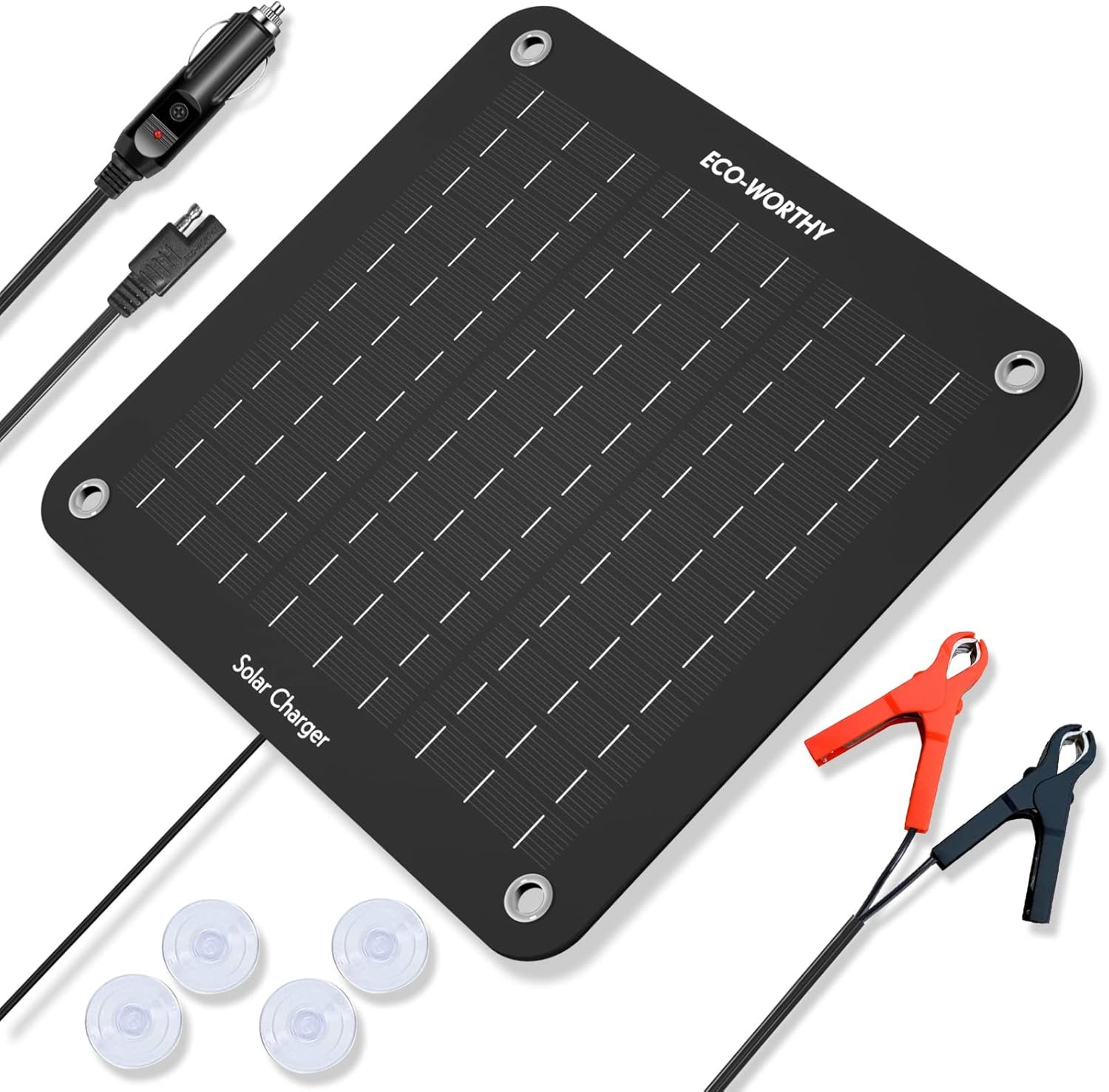
The ECO-WORTHY 10W Solar Battery Charger is the top low-watt trickle charger on Amazon’s bestselling chargers — it’s perfect for maintaining the charge of 12V batteries used in automobiles, trucks, motorcycles, boats, campers, RV systems, and other seasonal devices.
This 10W monocrystalline panel will trickle-charge your battery to keep it healthy and help prevent unsightly rust and mould. The built-in blocking diode prevents your battery from discharging back through the solar panel at night, and recent PCB upgrades provide enhanced safety against reverse polarity and overcharging.
This trickle charger is super light at 11.2 ounces, and you can stick it to a windshield or dashboard, as well as use it under the hood outdoors for maintenance. A charging status indicator on the back lets you know when it is charging, and installation takes less than 3 minutes thanks to the included SAE connector, cigarette lighter plug, and alligator clips.
This trickle charger isn’t for reviving a dead battery, but it is great for maintaining good batteries, particularly for items you don’t use daily or for equipment stored away for weeks.
How a Solar-Powered Car Battery Charger Works
A car solar battery charger is nothing more than a panel and some basic circuitry. The panel captures sunlight and produces DC electricity – usually 12 volts, intended for a car battery. They frequently house more efficient monocrystalline cells (20-30% efficiency) and tempered glass, and can produce 0.5-1 A in full sunlight (0.55 A is one possible value for a 10W, 18V panel). A built-in controller or circuit governs charging at a gentle trickle so it doesn’t go too fast or too slow. Top-end models employ intelligent charging techniques, such as MPPT or multi-stage charging, to better replenish batteries.
In practice, you’d either clip the charger to your battery or plug it into your lighter/OBD port and leave the car in the sun. Then, it gives a trickle charge when solar power is available, offsetting minor power drains.
One way to think of it is adding a glass of water every day to a slowly leaking bathtub: enough so that the level never drops. Or imagine your battery as an energy piggy bank, with the solar maintainer making small deposits to ensure it doesn’t go broke. These are not chargers for boosting a dead battery; they’re for maintenance. If your battery is already dead, you will still need a jump start or a larger charger. Use them regularly, though, and they keep a battery topped up, avoid excessive charging, and extend battery life.
In short, A solar-powered car battery charger uses sunlight to provide a gentle trickle charge, maintaining your battery’s health and preventing it from dying, but it cannot revive a completely dead battery.
Read more about our top 7 solar phone chargers hereHow to Choose a Solar Car Battery Charger?
With so many options, how do you choose a car battery charger? These are the factors I keep in mind when shopping for other people — ones informed by actual tests and reviews:
Wattage & Output: How quickly it is able to charge. Small maintainers are usually 4–10W (0.25–0.5A), which is suitable for slow charging or just topping up the cells. Larger panels (20-30W) will pump out up to 1–2A in strong sun, which can be awesome when your battery is completely low, or you’re living it up electronic style while parked. Just remember: more watts = a larger panel size. If you are simply looking to offset a daily drain (usually 1–2 Ah per day 4), then even a 5W unit will suffice. But for trucky recoveries or power-hungry setups, bump up to 10–20W.
Panel Type & Efficiency: The smallest type is monocrystalline panels (dark blue/black cells), which are more efficient and smaller compared to polycrystalline (blue cells). Higher-efficiency panels save space in your dash or on your roof. For instance, ~21–30% efficiency [24] 20W mini-panels can be found at present. If you’re working with limited window space (say, a boat cabin or motorhome window), choose a high-efficiency panel.
Connection & Support: For cars, connection and support are supposed to be 12V only since it becomes the source of power. Ensure it supports the type of battery you own (lead-acid, AGM, Gel, etc.). Then observe how it’s connected: cigarette lighter plug, alligator clips, ring terminals, or OBD-II plug. Alligator clips (to battery posts) are common; a cigarette lighter plug is convenient, but some cars disconnect the lighter socket with the key off. OBDII offers a no-battery-access solution. The best kits include a selection of adaptors. For example,
Power: This 5W charger comes with a cigarette adapter; alligator clips, ring terminals, and a SAE quick disconnect 12 are included – what great versatility.
Charge Controller / Safety: There’s also some protection built into the dumb panels as well. Find blocking diodes to prevent reverse drain at night, as well as overvoltage protection, so you don’t overcharge the battery. The better chargers have smart MPPT or multi-stage charging to both get the most juice out of the panel and keep the batteries at 13.10 health. E.g., the SunerPower 12W Pro with “ultra-smart MPPT” and a 3-stage algorithm to maximize charging 14 (helpful if you’re trying to get the fastest recoveries or are in a low-sun region).
Portability & Mounting: Consider where you are going to use it and how. Folding panels with kickstands or carry packs (such as Eco Flow’s 110W foldable) are fantastic for camping and can pull double duty as emergency gear. Slim, stiff panels with suction cups are easy to stick on a garage window or the roof of an RV. Strong: I like panels tough enough to have tempered glass and be sealed frames for outdoors. Weight might be an issue if you hike long distances on foot or regularly climb ladders.
Price: Trickle chargers can be inexpensive (frequently less than $30 for a 5–10W kit). Higher-wattage or brand-name kits (Renogy, EcoFlow, Jackery, etc.) can cost $50–150 or more. You get what you pay for: Cheaper kits may be low-powered or flimsy, while more expensive ones tend to offer better efficiency and features.
In summary: balance your needs. But if you’re only topping up a weekend warrior driver, then any 5–10W kit (clamp style or lighter plug) could do the trick. If you are traveling in an RV with a deep-cycle house battery, go big (20–50W portable panels with MPPT). Just make sure it is rated for automotive use (waterproof/dustproof).
Bottom line: Go for a solar charger that’s easy to carry, charges your devices quickly, and can handle a little rough use. If the solar charger has a decent battery, offers multiple charging at once, water or dust resistance, or a flashlight, you’ll be set for any adventure without extra bulk.
Frequently Asked Questions
Q: How do I calculate what size panel I need?
A: Calculate the daily draining of power in your battery. Nowadays, they typically sit at 0.03-0.05A idle current (constant) + self-discharge (0.2%/day). This equates to roughly 1-2 amp-hours/day for your average 60Ah car battery. … a 5W panel can be expected to bring in 0.5-1Ah/day (if there’s good sun), so it could keep up with that drain. If you are running accessories on the battery (alarms, fridges, lights), choose a larger one (10–20W). To guide them, EcoFlow recommends balancing your amp-hour requirements: if they follow that 2 Ah/day rule, a 10W panel (5V×2A) is more than capable of offsetting it with just a couple of good sun-hours. For weekend warriors or travel trailers with larger batteries, I would err on the side of caution and go with 20W or more to stay ahead of it.
Q: Can I hook these solar chargers up to any old 12V battery?
A: The vast majority of trickle maintainers are designed for standard 12V lead-acid batteries - flooded, AGM, gel, etc. And many of them say it is compatible with all of these chemistries. Some newer chargers also accommodate 12V lithium (LiFePO4), but check the specs. Never use one on 24V systems (some trucks) unless it’s specifically built for this.
Q: Will a 5W charger really be able to keep the battery from dying all winter?
A: It varies by the amount of sunlight. Yes, during summer, a 5W will always keep up in the sun, well ahead of the small draw. And since panels produce less power in winter (fewer daylight hours), a 5W panel could barely keep up with a battery in moderate health. If you reside in the dark winter climes, you might still be subject to a slow bleed. For the direst cases, I’d pop for a 10W or 20W model in the winter, or plan to supplement a couple of times when you’re home. We’ve even heard of some users rigging a pair of 5W panels in parallel to their dash for winter care.
Q: Does it make a difference if it rains or snows?
A: You want good weatherproof maintainers, IP65 and up. Rain or snow on the panel’s face isn’t good because it blocks light, but when covered at a slight angle, water will run off and reveal direct sunlight, allowing charging again. Cold doesn’t harm solar output (cells, in fact, work better when chilled), though snow cover can block it. Once clean snow/ice off the panel whenever practical.
Q: Are solar maintainers worth it?
A: For me, absolutely. Ever since I began using one, however, the first engine start of the morning is no longer something I dread. In the past year alone, I’ve “caught” half a dozen neighbor cars and at least three neighbor house batteries from going dead. The 10W maintainer has already paid back its own cost once, without me buying a battery. Besides, in a far-off place, the freedom of not having to worry about a dead battery is priceless. As auto pros advise, eventually most people will find themselves with a dead battery — solar maintainers are a cheap form of insurance.
Q. What is a “trickle charger”? How does it work?” Q. What is the difference between a “trickle” charger and what’s called a “battery maintainer”?
A: Here, they’re pretty much one and the same — a wee charger that puts in a small current to offset drain. On low-power kits (like 4-5W), some sellers use “trickle charger,” and on larger ones, a more modern meaning thereof, like smarter charge control. But each is an attempt to sell me solar panels that will keep a battery charged.
Q: Do I require any special controller or battery to get solar?
A: For these automotive solar chargers, there is typically a “controller” already integrated (a blocking diode or simple regulator, for example). You simply plug the panel into the battery (with the included adaptors). You don’t need an external charge controller, as the product doesn’t require one; it’s designed for 12V batteries. Though if you’re building a larger system (anything with >50W panels), you may want to pair it with an MPPT charge controller for safety, but for these kits, just go by the instructions.